646-558-2225
The Hidden Complexity of Hyperscalers
Executive Summary
Hyperscale cloud platforms promise flexibility and scale, but often bring complexity, support challenges, and cost unpredictability. While suited to global enterprise needs, they’re not always ideal for mid-market businesses seeking control, clarity, and true partnership. This paper outlines the strategic drawbacks of hyperscalers and compares them to more tailored alternatives.
The Limitations of Hyperscalers
Major public cloud providers (AWS, Azure, Google Cloud) are designed for massive scale. That scale often creates friction for mid-sized businesses:
- Opaque Pricing: Usage-based billing, egress fees, and complex calculators complicate budgeting.
- Limited Support: Service often depends on self-help docs and tiered SLAs.
- Over-Engineering: Tools are built for global scale, making them hard to manage for leaner teams.
Vendor Lock-In: Proprietary tools and APIs create long-term dependency.
The result: businesses often swap internal complexity for cloud confusion.
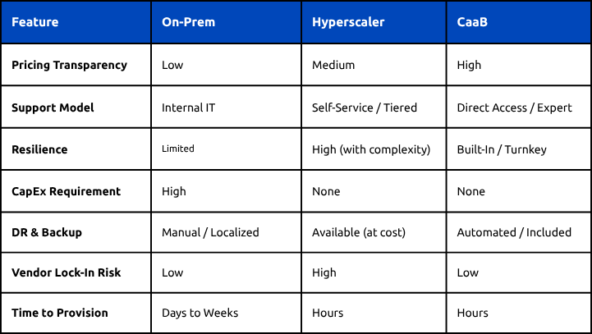
Comparative Snapshot
Infrastructure Feature Comparison
Summary
Hyperscalers deliver scale—but not simplicity. Mid-market organizations often need more predictable pricing, hands-on support, and a less complex experience. Purpose-built platforms like CaaB offer a more aligned path forward. The right infrastructure should reduce risk—not shift it.